
Roof Replacement in Spanish Fort, Alabama
Full roof replacement for Spanish Fort homes on the exposed Mobile-Tensaw Delta bluff. Southern Roofing Systems has reroofed Baldwin County since 2018, licensed and insured, with tear-off, deck re-nailing, and edge metal built for the higher-uplift ridge lines above US-31 and I-10.
- Serving Mobile & Baldwin County Since 2018
- Licensed & Insured in Alabama
- FORTIFIED™ Roof Expertise
- Free Roof Inspection
Replacement vs. Repair in Spanish Fort
A targeted repair makes sense when the damage is isolated, such as a lifted ridge/hip cap, a cracked pipe boot, or a short run of step/counterflashing at a chimney. If the deck is sound and the field shingles around the damage are intact, you can often stay with a repair.
A full replacement is the right call when a wind event has broken shingle seals across whole roof zones, when the roof-to-wall flashing and valley lining are failing in more than one place, or when your carrier is asking for a FORTIFIED reroof for renewal. On an exposed bluff home, scattered repairs rarely restore the uplift resistance a new sealed-deck assembly provides.
We inspect before we recommend. An honest assessment tells you whether a repair buys real time or just delays a replacement you already need.
Our Roof Replacement Process
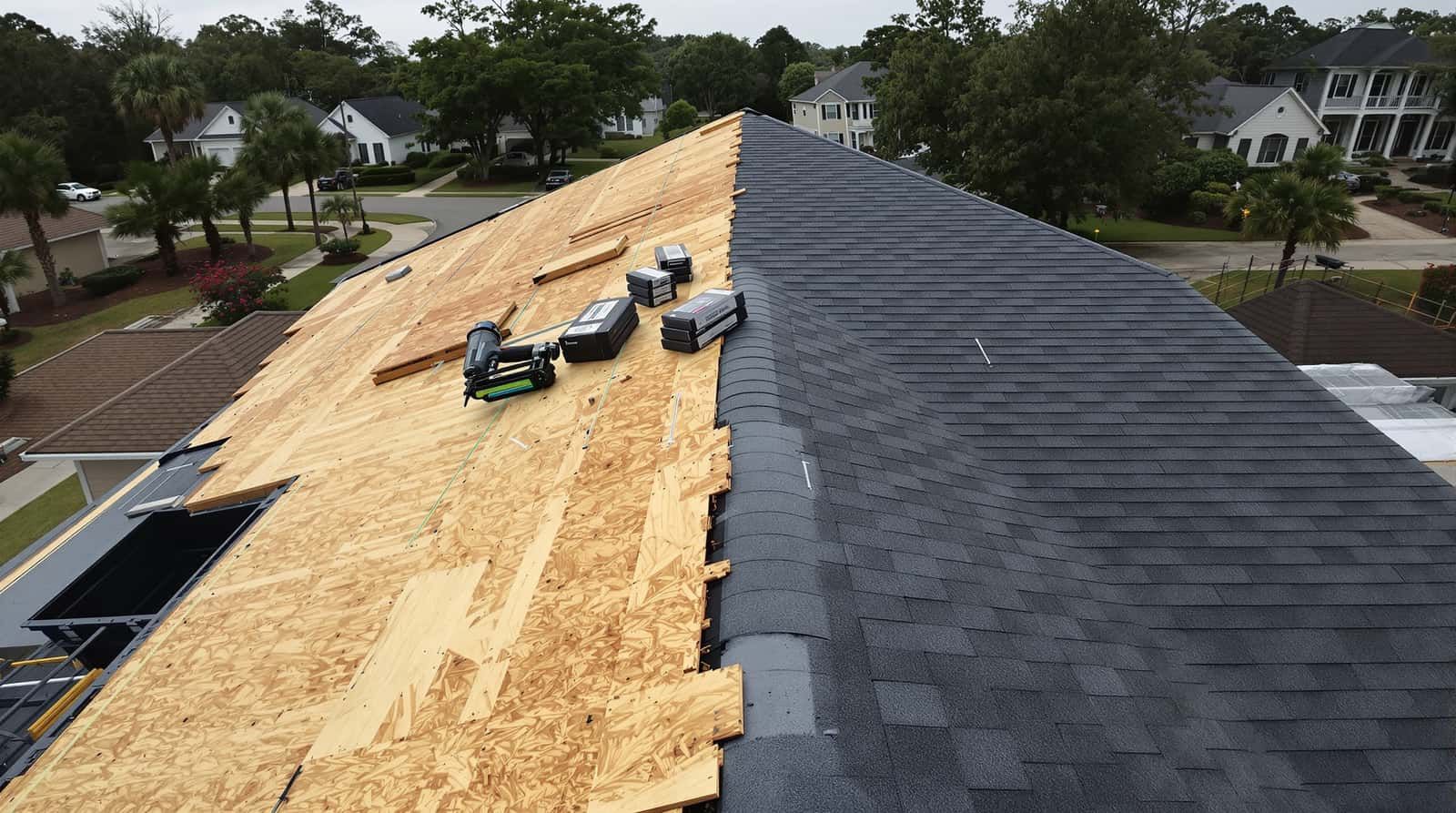
Everything starts with a complete tear-off down to the roof deck, because covering old layers hides the deck damage and fastener rot that matter most on a windward roof. Once the sheathing is exposed we can see exactly what your Spanish Fort roof is working with.
Next comes deck inspection and re-nailing. We replace any soft or delaminated sheathing, then re-nail the entire deck with 8d ring-shank nails on a tighter pattern, catching every unsupported sheathing edge so the roof deck resists negative uplift pressure. This deck re-nailing is the structural backbone of a wind-resistant reroof.
Then we build the sealed roof deck. We tape or seal the sheathing seams and roll a synthetic underlayment over the field, with a self-adhered membrane meeting ASTM D1970 at the eaves, valleys, and penetrations for a true sealed-deck method. This creates a secondary water barrier that holds even if wind strips shingles above it.
After that we set the edge metal and cover. Drip edge and edge flashing go on first, then a starter strip along every eave and rake, followed by high-wind field shingles rated to ASTM D3161 Class F or D7158 Class H, with reinforced ridge/hip cap, valley lining, new pipe boots, and step/counterflashing at every roof-to-wall.
We finish with ventilation, dry-in, and inspection. Balanced intake and ridge exhaust protect the new deck, and once the assembly is dried-in we pull the Baldwin County permit and schedule the final inspection so the work is documented and code-compliant.
Why Spanish Fort Roofs Need More Edge Attachment
Spanish Fort sits on an exposed bluff ridge above the Mobile-Tensaw Delta, so homes along US-31, I-10, and neighborhoods like Rayne's Ridge and Stonebridge see a more open exposure category than sheltered inland lots. That open fetch pushes the design wind loads on your roof higher for the same storm.
Wind does the most damage at the roof zones. Uplift concentrates at the perimeter and corner zones long before it stresses the field, which is why we specify heavier edge metal, closer nailing at the perimeter, and mechanically reinforced ridge/hip cap attachment on bluff-line roofs. The Vult, or ultimate design wind speed, is the input engineers use to size those tested assemblies for our part of Baldwin County.
New-construction subdivisions get the same scrutiny. Whether it is a 2000s home in Spanish Fort Estates or an older house near the ridge, we build the perimeter and corners to carry the load the delta bluff actually delivers.
FORTIFIED Reroof in Spanish Fort
Many Spanish Fort insurers now expect a FORTIFIED roof for coverage or renewal, and we build reroofs to the FORTIFIED standard, using the sealed-deck method, ring-shank deck fastening, and edge-metal details the program requires. The framing is verified so the tested assembly is documented, not assumed.
The designation itself is confirmed by a third party. An independent certified FORTIFIED Evaluator inspects and certifies the roof, not the roofing contractor, so you get an objective record your carrier will accept. We coordinate with the evaluator and provide the photos and product data they require.
FORTIFIED can lower the wind portion of your premium. Verified programs commonly report 35-60% off the hurricane portion and 20-35% off the other-wind portion, though you should verify the exact credit with your carrier. Alabama's Strengthen Alabama Homes grant can provide up to $10,000 toward a qualifying FORTIFIED Roof.
Silver vs. Gold, Honestly
FORTIFIED Roof is the foundation both levels share: the sealed roof deck, enhanced edge metal, and high-wind cover. Many Spanish Fort homeowners reroofing for insurance start here.
Silver and Gold add structural verification beyond the roof. Silver adds attention to attached structures and openings, while Gold adds engineered continuous load-path connections from roof to foundation. Which level your home needs depends on your carrier and your house, and we will walk you through it plainly instead of overselling.
Warranty and What to Expect
Your reroof carries two layers of protection. The shingle manufacturer's material warranty covers the products, and our workmanship warranty covers the installation, so a flashing or fastening detail is our responsibility to make right.
Ordinance-or-law and depreciation matter on insurance jobs. If your policy carries ordinance-or-law coverage it can help fund code-required upgrades a tear-off triggers, and recoverable depreciation is released once the completed work is documented at final inspection. We keep the paperwork clean so nothing is left on the table.
Expect a straight answer from start to finish. From the first inspection on your Spanish Fort roof to the evaluator's FORTIFIED certificate, we tell you what the roof needs and what it does not.
Roof Replacement Built for Spanish Fort's Specific Conditions
Every roof replacement in Spanish Fort follows Gulf Coast specifications — not national averages. High-wind fastening fastener patterns, sealed roof deck assembly with peel-and-stick membrane at eaves and rakes, and materials selected for Baldwin County's wind and humidity conditions. Call (251) 220-8496 for a free roof inspection.
Roof Replacement Coverage Across Spanish Fort
We serve every part of Spanish Fort and the surrounding Baldwin County communities. Our local Eastern Shore crew covers Spanish Fort Estates, Rayne's Ridge, Stonebridge, as well as nearby communities including Daphne, Mobile, Bay Minette. For a full overview of everything we handle in Spanish Fort, AL, see our city page.
- Spanish Fort Estates
- Rayne's Ridge
- Stonebridge
- Daphne area
- Mobile area
- Bay Minette area
For the full details on materials, costs, and what to expect — read our complete Roof Replacement guide.
Roof Replacement FAQs for Spanish Fort, Alabama
Does my Spanish Fort home need FORTIFIED Silver or Gold?
It depends on your carrier and your house, and the honest answer is that many homeowners reroofing for insurance only need the FORTIFIED Roof foundation. Silver adds verification for attached structures and openings, and Gold adds an engineered continuous load path from roof to foundation. We will review your policy requirements and your home before recommending a level, rather than pushing the most expensive option.
Why does ridge and edge attachment matter so much on the bluff?
Spanish Fort roofs sit above the Mobile-Tensaw Delta on an exposed bluff with a more open exposure, so wind uplift is stronger here than on sheltered inland lots. Uplift concentrates at the perimeter and corner roof zones and along the ridge before it ever stresses the field of the roof. That is why our replacements use heavier edge metal, tighter perimeter nailing, and reinforced ridge and hip cap attachment.
Who actually certifies a FORTIFIED roof, the roofer or someone else?
An independent certified FORTIFIED Evaluator certifies the roof, not the roofing contractor, which keeps the designation objective. We build the reroof to the FORTIFIED standard and document the sealed deck, fastening, and edge details, then the third-party evaluator inspects and issues the certificate. That separation is exactly what makes carriers accept it.
Can I just repair my roof instead of replacing it?
Sometimes yes, when the damage is isolated to a few shingles, a pipe boot, or a short run of flashing and the deck underneath is sound. But when wind has broken seals across whole roof zones or your carrier is requiring a FORTIFIED reroof, scattered repairs will not restore the uplift resistance the bluff demands. We inspect first and tell you honestly which path your Spanish Fort roof needs.
Do you handle the permit, final inspection, and warranty?
Yes, we pull the Baldwin County permit for your replacement and schedule the final inspection so the work is documented and code-compliant. Your reroof is backed by the shingle manufacturer's material warranty and our own workmanship warranty on the installation. We also keep the paperwork clean so any recoverable depreciation on an insurance claim can be released once the job is verified.
Licensed Roofing Contractors Near Spanish Fort
Ready for a roof built for the Spanish Fort bluff? Call (251) 220-8496 for a straight-talk replacement assessment, FORTIFIED reroof guidance, and coordination with an independent FORTIFIED Evaluator across Spanish Fort and Baldwin County.
Licensed & Insured · Spanish Fort & Baldwin County · Gulf Coast Roofers Since 2018